
Why Margarine Is Unhealthy: What Science Really Says
For decades, margarine was marketed as a “heart-healthy” alternative to butter. However, modern research paints a very different picture. Why margarine is unhealthy is no longer a fringe question, but a legitimate nutritional concern supported by biochemical, epidemiological, and clinical evidence. While margarine was originally promoted to reduce saturated fat intake, its industrial origins, fatty acid composition, and long-term health effects raise serious red flags.
In this article, we will explore why margarine is unhealthy, how it is made, how it affects the body, and why many health experts now recommend avoiding it altogether. Moreover, we will compare margarine to natural fats, analyze ingredient labels, and explain what science actually says, without myths or exaggerations.
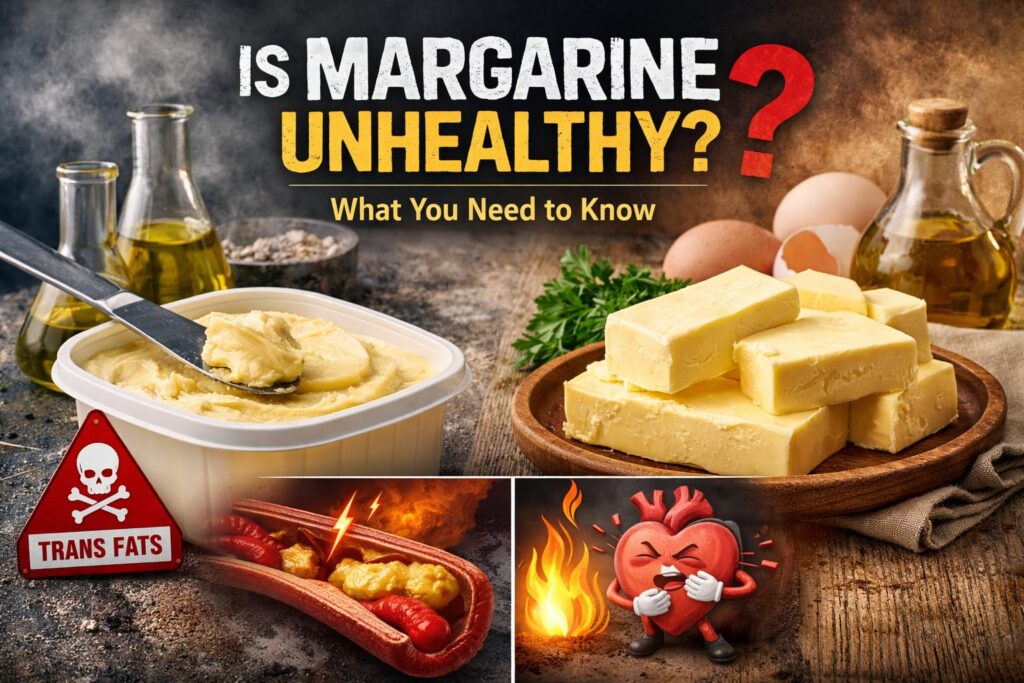
Why Margarine Is Unhealthy: How It Is Made
To understand why margarine is unhealthy, we must first look at how it is produced.
Margarine is not a natural food. Instead, it is an industrial product created through a complex chemical process called hydrogenation or interesterification. Vegetable oils, often soybean, corn, sunflower, or canola, are extracted at high temperatures using chemical solvents such as hexane. After that, the oils are refined, bleached, and deodorized.
As a result, the original oil loses most of its natural antioxidants and nutrients. Therefore, manufacturers must later add synthetic vitamins to make the product appear nutritionally adequate.
Furthermore, to make liquid oils solid at room temperature, they undergo chemical modification. Historically, this process produced trans fats, which are now widely recognized as harmful. Although many modern margarines are “trans-fat free” on paper, the reality is more complicated.
Why Margarine Is Unhealthy Due to Trans Fats
Even though labels often claim “0 g trans fat,” why margarine is unhealthy still largely relates to trans fatty acids.
First of all, food regulations allow products to contain up to 0.5 g of trans fat per serving and still claim zero. Consequently, frequent consumption can easily lead to significant intake.
Secondly, newer processes like interesterification may avoid classic trans fats, but their metabolic effects are not fully understood. Some studies suggest they may still disrupt glucose metabolism and lipid profiles.
Trans fats are known to:
-
Increase LDL (“bad”) cholesterol
-
Decrease HDL (“good”) cholesterol
-
Promote systemic inflammation
-
Increase the risk of cardiovascular disease
Because of these effects, the World Health Organization has called for the global elimination of industrial trans fats.
Why Margarine Is Unhealthy for Heart Health
Ironically, margarine was originally promoted as heart-friendly. However, why margarine is unhealthy becomes especially clear when examining cardiovascular outcomes.
Several long-term observational studies have found that replacing butter with margarine does not reduce heart disease risk. In fact, some data suggest it may increase it. This is because industrial fats interfere with endothelial function, promote arterial inflammation, and alter lipid particle size.
Moreover, oxidized polyunsaturated fats, abundant in margarine, are particularly damaging to blood vessels. When heated or stored for long periods, these fats easily oxidize, forming compounds that accelerate atherosclerosis.
Thus, rather than protecting the heart, margarine may silently undermine it.
Why Margarine Is Unhealthy Compared to Butter
When comparing butter and margarine, context matters. Butter is not perfect, but why margarine is unhealthy becomes obvious when contrasted with a minimally processed fat.
Butter:
-
Is made from cream
-
Contains fat-soluble vitamins (A, D, K2)
-
Has a stable fatty acid profile
-
Is minimally processed
Margarine:
-
Is ultra-processed
-
Contains emulsifiers, stabilizers, and colorants
-
Is rich in omega-6 fatty acids
-
Often includes artificial additives
Additionally, butter contains short-chain and medium-chain fatty acids that are easier to metabolize. Margarine, on the other hand, delivers fats the body struggles to recognize and use efficiently.
The Problem of Omega-6 Fatty Acid Imbalance
Another key reason why margarine is unhealthy lies in its fatty acid ratio.
Most margarines are extremely high in omega-6 fatty acids. While omega-6 is essential in small amounts, excessive intake, especially without enough omega-3, promotes chronic inflammation.
Modern diets already contain too much omega-6. Margarine only worsens this imbalance. Over time, this can contribute to:
-
Inflammatory diseases
-
Insulin resistance
-
Obesity
-
Autoimmune disorders
Therefore, regular consumption may silently fuel inflammation throughout the body.
Why Margarine Is Unhealthy for Metabolic Health
Beyond heart disease, why margarine is unhealthy also extends to metabolic disorders.
Artificial fats interfere with insulin signaling. As a result, glucose uptake becomes less efficient. Several studies associate high intake of industrial fats with increased risk of type 2 diabetes.
Furthermore, emulsifiers commonly added to margarine may negatively affect the gut microbiome. An altered microbiome is increasingly linked to metabolic syndrome, weight gain, and systemic inflammation.
Thus, margarine’s impact goes far beyond calories alone.
Why Margarine Is Unhealthy: Ingredient List Breakdown
Reading the label explains a lot about why margarine is unhealthy.
Common ingredients include:
-
Refined vegetable oils
-
Mono- and diglycerides
-
Artificial flavors
-
Preservatives
-
Synthetic vitamins
-
Colorants like beta-carotene
Each of these ingredients exists to correct a problem created during processing. In other words, margarine requires chemical fixes to resemble real food.
Moreover, many emulsifiers used are also found in ultra-processed foods linked to negative health outcomes.
How Industrial Spreads Contribute to Chronic Inflammation
Chronic inflammation is a root cause of many diseases. Unfortunately, why margarine is unhealthy strongly correlates with its inflammatory potential.
Oxidized fats, omega-6 excess, and artificial additives all stimulate inflammatory pathways. Over time, this can affect joints, blood vessels, the brain, and even skin health.
In contrast, natural fats such as olive oil or butter from grass-fed cows tend to be anti-inflammatory when consumed in moderation.
Why Margarine Is Unhealthy According to Recent Studies
Recent research continues to reinforce why margarine is unhealthy.
Large cohort studies have found associations between margarine consumption and:
-
Higher mortality rates
-
Increased cardiovascular events
-
Greater incidence of metabolic disorders
While correlation does not equal causation, the consistency of findings across populations is concerning.
Furthermore, when trans fats were reduced in the food supply, heart disease rates declined. This strongly suggests a causal role of industrial fats.
Why Margarine Is Unhealthy for Children and Hormones
Children are especially vulnerable. Why margarine is unhealthy matters even more during growth and development.
Industrial fats may interfere with hormone signaling, cell membrane formation, and brain development. Since the brain is largely composed of fat, the quality of dietary fats is critical.
Similarly, some additives may act as endocrine disruptors, potentially affecting hormonal balance over time.
Healthier Alternatives to Margarine
If why margarine is unhealthy is now clear, the next question is: what to use instead?
Healthier options include:
-
Extra virgin olive oil
-
Butter (preferably grass-fed)
-
Ghee
-
Avocado oil
-
Coconut oil (in moderation)
These fats are either minimally processed or naturally stable, making them safer choices for regular consumption.
Is Any Margarine Healthy?
Some brands market “natural” or “plant-based” spreads. However, why margarine is unhealthy still applies in most cases.
Even improved formulations remain processed foods. While some may be less harmful, they are rarely beneficial. Therefore, moderation is key, and whole-food fats remain superior.
Final Thoughts: Why Margarine Is Unhealthy
In conclusion, why margarine is unhealthy is no longer a controversial topic. Its industrial production, fatty acid imbalance, inflammatory potential, and metabolic effects make it a poor dietary choice.
While it was once seen as a healthier alternative, modern science has largely overturned that narrative. Choosing real, minimally processed fats is a simple yet powerful step toward better health.
Ultimately, food should nourish the body, not confuse it. And when it comes to margarine, the evidence suggests it does more harm than good.